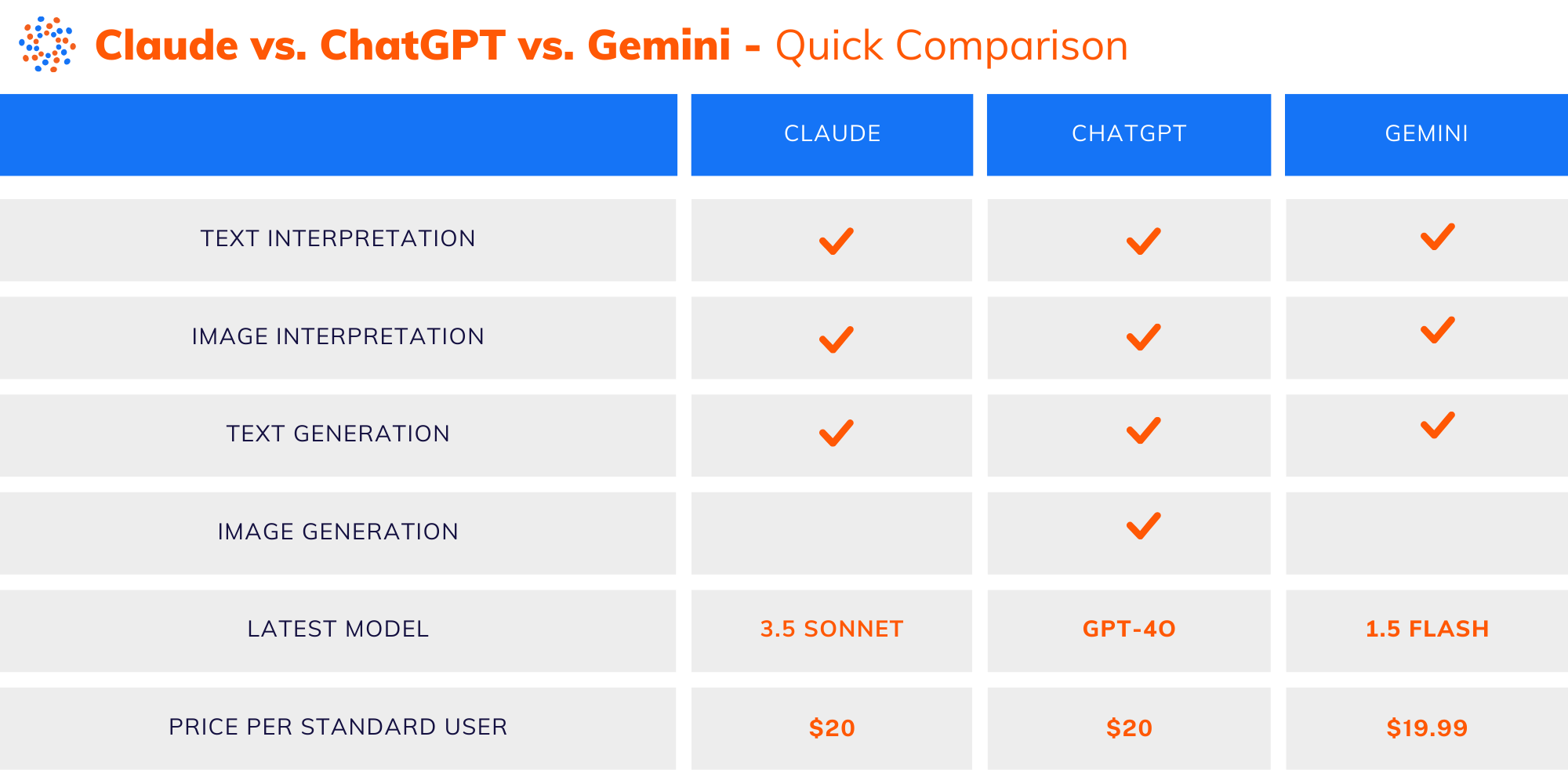
> TL;DR: A full cost breakdown of Claude, GPT-4, and Gemini — from per-token pricing to hidden costs you’re probably overlooking, with clear recommendations by budget and use case.
When picking an AI model for a project, cost is one of the most important factors developers tend to skip. Claude 3.5 Sonnet is surging on accuracy, but it’s not cheap. GPT-4 Turbo is still the industry benchmark. Gemini Pro stands out on price.
Beyond per-token rates, you need to factor in hidden costs: retries when a model gives a wrong answer, and the different rate limits each provider enforces. If budget is tight, start with Gemini Pro. If you need top accuracy and budget isn’t the constraint, Claude is the most compelling choice.
Selection comes down to use case and available budget.
Pricing Comparison at a Glance
The numbers make the tradeoffs obvious. GPT-4 sits in the middle — both on price and performance. Claude is the most expensive but delivers the best response quality.
Looking at per-token rates alone isn’t enough — context window matters too. Gemini Pro gives you 2M tokens at a low price, ideal for long-document processing. Claude and GPT-4 have shorter contexts but tend to be more precise.
For startups on a tight budget, Gemini is the right starting point. For enterprise work that needs high accuracy, Claude is worth the premium.
Why AI Cost Actually Matters
Last month I integrated GPT-4 into a chatbot without thinking about costs at all. Set up auto-scaling, left it running. First week was great — then I saw the bill. Almost 10,000 baht (~$280 USD). I’d completely miscalculated how many tokens each user query would burn.
The problem with AI model costs is they spike without warning, especially under high traffic or when processing large inputs. Each model has different input/output token pricing. Pick wrong, and your budget explodes.
Choosing an AI model is like choosing the right tool for a job — you need to match precision requirements to the budget available. Sometimes a cheaper model that fits the task beats spending a premium on a flagship.
Where Each Model Sits in the Market
Claude 3.5 Sonnet currently owns the coding assistant crown — strong at programming and analysis that requires complex logic. Claude 3 Haiku is the budget option for basic tasks.
GPT-4o remains the general-purpose champion, capable across all task types. GPT-4o mini has become the sweet spot for those who want near-GPT-4o quality at lower cost — multimodal support included.
Gemini Pro enters the race with the longest context window at 2 million tokens, designed for heavy document processing at a competitive price.
The AI market has split clearly: Claude for dev work, GPT-4 for general tasks, Gemini for heavy data processing.
New vs Old Generation Comparison
| Factor | GPT-3.5 vs GPT-4 | Claude 2 vs Claude 3 | Gemini Pro vs Ultra |
|---|---|---|---|
| Input Price | $0.5 → $10 | $8 → $15 | $0.125 → $60 |
| Output Price | $1.5 → $30 | $24 → $75 | $0.375 → $120 |
| Context Window | 4K → 128K | 100K → 200K | 32K → 2M |
| Multimodal | No → Yes | No → Yes | Yes → Yes |
Every new generation is significantly more expensive, but you get substantially more features. GPT-4 is 20x the price of GPT-3.5, but you get vision and a much longer context. Claude 3 costs a bit more but doubles the context window.
Gemini Ultra is the most expensive because it’s the flagship — but that 2M token context is enormous. You can feed in a full-length book and summarize it on the spot.
If budget is tight, older generations still work fine — just match them to appropriate tasks and save the new models for genuinely complex work.
Real-World Performance
Long-form writing: Gemini Ultra is outstanding — 2M token context means you can drop in a 50-page document and summarize it immediately. Claude writes more naturally, making it better for blog posts or marketing copy.
Data analysis: GPT-4 Turbo is the most accurate — great at pulling insights from tables. For large files, Gemini handles the scale better.
Translation: Claude is the best here. Translations read naturally, not like machine output. GPT-4 translates well too, but sometimes leans too literal.
Coding: GPT-4 has the edge — fast debugging, clear logic explanations. Claude can write code but occasionally struggles with complex algorithms.
Choose the model by job type, not just price.
Head-to-Head Comparison
| Factor | Claude 3.5 Sonnet | GPT-4 Turbo | Gemini Pro |
|---|---|---|---|
| Price per 1M tokens | $3 input / $15 output | $10 input / $30 output | $0.50 input / $1.50 output |
| Context window | 200K tokens | 128K tokens | 1M tokens |
| Speed | Fast | Medium | Very fast |
| Coding | Good | Excellent | Good |
| Thai language | Excellent | Good | Adequate |
Gemini Pro wins on price — cheapest of the three, with the largest context window at 1M tokens. Ideal for long-document workloads.
GPT-4 is the most expensive, but the best at writing code and solving complex problems. If you can afford it, it’s worth it.
For general use, Claude is the balanced choice — mid-range price, excellent Thai language handling. If budget is the primary constraint, Gemini wins on value.
Pros and Cons of Each Model
Pros
- +Claude: best writing quality and Thai language output, great for content and document analysis
- +GPT-4: best at coding, strongest complex problem solving
- +Gemini: most cost-effective, large 1M token context, excellent Google services integration
Cons
- −Claude: response latency is slower than competitors
- −GPT-4: most expensive — can hurt budget under heavy usage
- −Gemini: still maturing, uneven performance on some task types
Each model has its own strength. Claude fits document-heavy analysis. GPT-4 is for developers who need premium quality. Gemini suits budget-constrained teams.
Use each model for what it’s good at — you don’t need to pick just one. Mix and match based on the task for the best ROI.
Hidden Costs
Beyond token charges, there are costs people regularly miss. API rate limits push you into a higher tier faster than expected — a 5-person dev team can blow through quota quickly.
Fine-tuning is another money pit. Claude and Gemini still have limited fine-tuning options, but GPT-4 starts at $3 per million tokens for training data. Infrastructure costs — GPU rental or hosting a custom model — can add tens of thousands of baht per month.
Prompt optimization burns money quietly because it requires multiple iterations to tune. Budget 30-40% over your initial estimate, because production usage almost always runs higher than you expect.
Who Should Use Which Model
Startups on a tight budget: Start with Gemini Pro at $0.50 per million tokens — the cheapest option. Good for basic chatbots or content generation.
Mid-size businesses: Claude 3.5 Sonnet at $3 per million tokens delivers premium quality at a reasonable price. Strong for customer service or document analysis that needs accuracy.
Enterprise with budget: GPT-4 Turbo at $30 per million tokens is the most expensive, but delivers the best performance for complex reasoning or production-grade code generation.
Start with Gemini, switch to Claude as traffic scales. If budget is no object, go straight to GPT-4 — just be ready to pay 5-10x more.
Summary and Recommendations
Starting point: Gemini Flash at $0.075 per million tokens is the cheapest option. Ideal for prototyping or startups validating a concept before committing to production infrastructure.
Mid-tier: Claude 3.5 Sonnet at $3 per million tokens is the best balance of price and quality for standard production apps.
Before switching: Calculate actual monthly token usage, check latency requirements, and evaluate which model best fits your specific use case.
Don’t get attached to an expensive brand name. If Gemini gets the job done, there’s no reason to switch. A 10x cost reduction has massive implications for your business model.